
Finasteride: what you should know about its use for hair loss and the prostate
Let's be clear. Finasteride is one of those medicines that many people immediately associate with hair loss. But it's not only used in that context. It also forms part of the treatment for certain cases of benign prostatic hyperplasia.
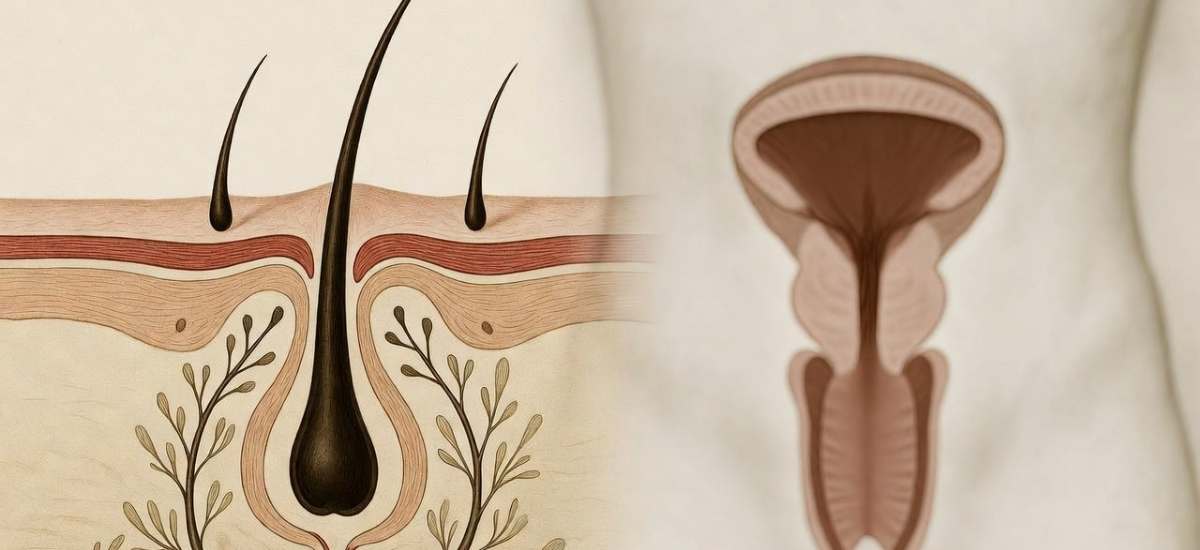
What finasteride is and why it is used
Finasteride is a prescription medicine belonging to the group of 5-alpha-reductase inhibitors. Simply put: it acts on a hormonal pathway related to both male androgenetic alopecia and prostate growth.
Therefore, its main use is in two different scenarios: male pattern hair loss, in certain stages, and symptomatic benign prostatic hyperplasia, when there is an increase in prostate size and associated urinary symptoms.
How it acts on hair and the prostate
Finasteride reduces the conversion of testosterone into dihydrotestosterone, known as DHT. This hormone plays a relevant role in the progressive miniaturisation of the follicle in androgenetic alopecia and also in prostatic growth in benign prostatic hyperplasia.
On the scalp, this effect can help slow the progression of hair loss in some men. In the prostate, it can help reduce prostatic growth and improve symptoms such as a weak stream, difficulty starting to urinate, or the feeling of incomplete emptying.
In which cases is it really prescribed
In androgenetic alopecia, the Spanish data sheets for finasteride 1 mg focus on men with androgenetic alopecia in initial stages. Furthermore, these same data sheets indicate that its efficacy has not been established in bitemporal recession or in final stages of hair loss.
In benign prostatic hyperplasia, for finasteride 5 mg, the indication is different: it is used in men with symptomatic benign prostatic hyperplasia and increased prostate size, with the aim of improving symptoms, reducing the risk of acute urinary retention, and decreasing the likelihood of needing surgery.
What results can be expected and what are its limitations
In androgenetic alopecia, official sources insist that treatment should not be evaluated hastily. It may take between 3 and 6 months to start seeing stabilisation or improvement, and the real assessment is usually made within the first year.
In benign prostatic hyperplasia, the logic of immediate results should also be avoided. Official sources indicate that it can take up to 6 months for its effect to be fully noticed.
Side effects and precautions that should not be overlooked
Like any medicine, finasteride can cause adverse effects. Among the most well-known are decreased libido, erectile dysfunction and changes in ejaculation. The package leaflets and data sheets also list depression or mood changes, testicular pain, breast abnormalities, and allergic reactions in some cases.
There are also several practical precautions worth remembering. Finasteride is not indicated for women, and pregnant women or those who may become pregnant should not handle broken or crushed tablets. Furthermore, if you are going to have a PSA test, it is important to inform that you are taking finasteride, as it can alter the interpretation of that test.
What to remember before making a decision
Finasteride should not be understood as a shortcut or an automatic answer to any hair loss or any urinary symptom.
It is reasonable to place it where it truly belongs: as a medicine with specific indications, response times that require patience, possible but not universal benefits, and adverse effects that deserve a serious conversation, not a passing comment.
You may also be interested in reading about Viagra and sildenafil and erectile dysfunction generics.
